

Open Letter to Premier Susan Holt and Minister of Natural Resources John Herron - Supporting the Maple Syrup Industry to Strengthen New Brunswick’s Economy and Rural Communities

Dear Premier Holt and Minister Herron,
Over the past twenty years, New Brunswick’s maple syrup industry has undergone a remarkable transformation. Thanks to investments by producers, technological advances, and access to additional Crown land, our province now ranks third in the world in maple syrup production, behind Quebec and Vermont.
Few sectors of our economy can claim such a position on the world stage. Even more remarkable is the fact that our industry has achieved this standing while occupying less than 1% of Crown land. Imagine what it could accomplish with the space needed to continue growing.
An Economic Opportunity We Must Seize Now
At a time of economic uncertainty, trade tensions, and challenges facing several traditional industries, maple syrup production offers New Brunswick a particularly promising opportunity for economic development. The entrepreneurs are here. The demand is here. The expertise is here. The technology is available. And producers are ready to invest. The main factor now limiting this growth is access to the resource.
This opportunity is particularly significant today. International demand for maple syrup has been growing steadily for the past twenty years, and that trend is accelerating. Exports, an important indicator of developments in the global market, increased by 9.34% in 2024 and 15.8% in 2025. Meanwhile, the strategic maple syrup reserve, which helps stabilize supply and offset fluctuations in production, has now been depleted.
The depletion of this reserve highlights the need to increase production to meet demand and avoid missing business opportunities. Yet in New Brunswick, during the most recent request for proposal for maple syrup production areas on Crown land in 2024, 26 projects that met the eligibility criteria were unable to move forward because the total number of hectares made available was insufficient to accommodate them.
Behind these projects are entrepreneurs prepared to invest tens of millions of dollars in private capital in our economy, primarily in rural communities. Every year of delay means postponed investments, lost revenues, and economic opportunities that could slip away.
Maple Syrup Production and Forestry: Two Complementary Activities
There remains a perception that expanding maple syrup production would come at the expense of the forestry industry, as though both industries were competing for the same resource. This is a false debate. In fact, the two are complementary.
A healthy sugar bush requires active management. Silvicultural treatments are necessary during its establishment and throughout its development to promote maple tree growth, maintain healthy stands, and ensure forest regeneration. These activities generate wood that can be supplied to sawmills and other processing facilities throughout the province.
With appropriate silvicultural prescriptions, it is possible to produce both maple syrup and wood on the same land while maintaining long-term forest health. Maple syrup production also offers an important environmental benefit: its profitability depends on maintaining a healthy forest canopy. It therefore helps reconcile economic development, sustainable forest management, and ecosystem conservation. In addition, sugar bushes can provide a degree of natural protection against wildfires, as hardwood stands are generally less conducive to the spread of fire than coniferous forests.
Rather than pitting the forestry and maple syrup industries against each other, we should focus on sustainably maximizing the economic, social, and environmental benefits of our public forests. Wood processing plays an essential role in our economy, and its long-term viability matters to our communities. Sound forest resource management must support these activities while encouraging the development of the maple syrup industry and ensuring the protection of stands with a high density of sugar maple trees.
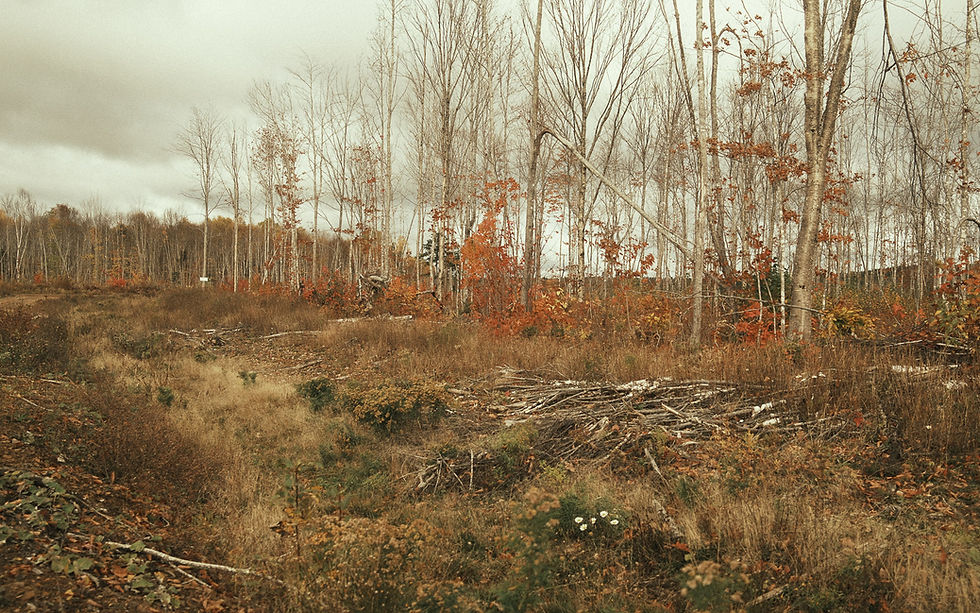
But time is running out. Anyone travelling through Crown forests, whether for work or recreation, can see the extent of logging in sugar maple stands. We must make the necessary decisions now to preserve this potential before it is too late.
Diversifying Our Forest-Based Economy
The challenges currently facing the forestry industry also call for a closer examination of how we make the best use of our resources. The temporary shutdown of the AV Nackawic mill, which is deeply concerning for workers and their community, illustrates the importance of diversifying our forest-based economy.
If these changes lead to a reassessment of certain forest allocations, maple syrup production must be among the options considered. High-potential stands could accommodate new sugar bushes or allow existing operations to expand, generating investments and jobs in our rural communities.
Unlike many other industrial investments, these economic benefits cannot be relocated elsewhere. A sugar bush established in New Brunswick will continue to produce, employ people, and generate economic activity here, year after year.
Giving Our Industry the Means to Grow
We are calling on the Government of New Brunswick to make the development of the maple syrup industry a genuine economic priority. We also invite all members of the Legislative Assembly, both government and opposition, to recognize its potential and support the following measures:
Identify and protect more areas of Crown land with high maple syrup production potential;
Gradually increase the land available for new projects and the expansion of existing operations;
Implement silvicultural practices that allow maple syrup production and forestry operations to coexist sustainably;
Systematically incorporate maple syrup production potential into forest management and resource allocation decisions;
Consider maple syrup production in any discussions concerning the reallocation of forest resources or land resulting from changes in the forestry industry.
We are not asking the government to take a chance on a hypothetical industry whose economic benefits have yet to be demonstrated. We are asking it to invest further in an industry that has already proven its worth, supports more than 500 full-time equivalent jobs, and still has exceptional growth potential.
As international demand continues to rise and the Canadian maple syrup industry seeks to expand its production capacity, New Brunswick has an opportunity to strengthen its position among the world’s leading producers. This opportunity is within our reach. Now is the time to seize it.
We would welcome the opportunity to discuss with you the measures needed to make this next stage of growth possible.
Yours sincerely,
Glenn Somers, President
Frédérick A. Dion, Executive DirectorNew Brunswick Maple Syrup Association
cc: All Members of the Legislative Assembly of New Brunswick


Comments